
Top 10 AI Agents in Web3 to Watch in 2026 (Compared by Use Case)
The top AI agents in Web3 for 2026 span three layers: platforms that launch agents, frameworks that build them, and standout agents that run live on-chain. The most-watched names include Virtuals Protocol, ElizaOS, Fetch.ai, and Bittensor on the infrastructure side, alongside application-layer agents like AIXBT, Griffain, and Luna. None of these is a guaranteed winner. The sector is young, volatile, and driven as much by narrative as by real usage.
AI agents in Web3 are autonomous programs that can analyze blockchain data, make decisions, and execute on-chain actions such as trades, swaps, or governance votes with little human input. In 2026 they have moved from a speculative experiment to one of crypto’s defining themes, with thousands of agents deployed and a handful generating real revenue. This guide compares ten of the most important projects by what they do, which chain they run on, and who each one suits.
This article is for general information only and is not investment advice. AI agent tokens are highly speculative and many trade far below their earlier peaks. Always do your own research and consult a qualified advisor before risking capital.
What Are AI Agents in Web3?

AI agents in Web3 are autonomous software systems that act on behalf of users, protocols, or DAOs by combining artificial intelligence with blockchain execution. Unlike a standard chatbot, a Web3 agent can hold a crypto wallet, read live on-chain data, and trigger smart contracts on its own.
The defining trait is autonomy. A Web3 agent can monitor markets, decide on an action, and carry it out without waiting for a human to click. Many also maintain a persistent personality and memory, which lets them post on social media, manage a treasury, or coordinate with other agents over time.
The result is a new category that sits between AI and DeFi. These agents power trading, governance, gaming, research, and on-chain coordination, and they are increasingly able to transact with each other, not just with people.
How Do AI Agents in Web3 Work?
Most Web3 agents combine three building blocks: a language model for reasoning, a framework for memory and actions, and a blockchain connection for execution.
The model handles understanding and decision-making, often using systems from OpenAI, Anthropic, Llama, or open-source alternatives. A framework such as ElizaOS or Virtuals’ G.A.M.E. engine gives the agent a defined character, persistent memory, and a set of tools it can call. Finally, plugins and APIs connect the agent to a wallet and to chains like Base, Solana, or Ethereum so it can move funds and interact with contracts.
The key point is that autonomy is powerful but not risk-free. An agent that can execute trades can also lose funds quickly if its logic is flawed or its keys are compromised, which is why security and oversight matter as much as capability.
Also Read: 7+ Best AI Driven Cryptocurrencies Making Waves this Year
How We Compared These AI Agents

To keep this list practical rather than hype-driven, each project below is assessed on real product usage and live deployment, the role it plays in the stack (platform, framework, network, or live agent), the chain it runs on, and the type of user it suits. Token prices and market caps move constantly and are not the focus here. What matters is what each agent or platform actually does and whether people are using it.
Top 10 AI Agents in Web3 to Watch in 2026
The projects below cover the full agent stack, from launchpads and frameworks to the networks underneath and the breakout agents running on top.
1. Virtuals Protocol
Virtuals Protocol is the leading platform for launching and co-owning tokenized AI agents, built primarily on Base with expansions across Solana, Ethereum, Ronin, and Arbitrum. Anyone can create an agent, which is paired with its own tradable token, so holders share in the agent’s revenue and on-chain activity.
Its G.A.M.E. framework handles agent reasoning, while the Agent Commerce Protocol (ACP) lets agents request, negotiate, and settle paid work with each other through on-chain escrow. With well over 17,000 agents launched, Virtuals is the closest thing the sector has to a central hub (virtuals.io).
Best for: builders and investors who want platform-level exposure to the agent economy rather than a single agent.
2. ElizaOS
ElizaOS is the most widely used open-source framework for building autonomous agents, written in TypeScript and often described as an operating system for AI agents. It is model-agnostic, supports multi-agent setups, and ships with connectors for Discord, Telegram, Farcaster, and major blockchains.
The project rebranded from ai16z in late 2025 and now runs as a community-governed framework with an active GitHub and a v2 release line. Because the code is free and open, developers worldwide use it as a base for trading bots, NPCs, and business-automation agents (elizaos.ai).
Best for: developers who want to build and customize their own agents across Web2 and Web3.
3. Fetch.ai and the Artificial Superintelligence Alliance
Fetch.ai is a long-running agent framework that now anchors the Artificial Superintelligence Alliance (ASI), a merger of Fetch.ai, SingularityNET, and Ocean Protocol under the FET token. It provides tools to build “autonomous economic agents” that negotiate and transact on a decentralized network.
The ASI vision is a shared, open infrastructure for decentralized AI, spanning agent frameworks, data marketplaces, and compute. That breadth makes it one of the most established names bridging serious AI research and Web3.
Best for: users and enterprises wanting infrastructure-grade decentralized AI and agent services.
4. Bittensor
Bittensor is a decentralized machine-learning network where independent models compete and are rewarded in its TAO token, organized into specialized “subnets.” It is consistently the largest AI crypto project by market capitalization and acts more as a foundation layer than a single agent.
Its relevance to agents is that it provides an open, incentivized marketplace for intelligence that agents and applications can tap into, rather than relying on centralized providers. For many, Bittensor represents the decentralized-AI thesis in its purest form.
Best for: those interested in the decentralized model and compute layer beneath the agent economy.
5. AIXBT
AIXBT is the most famous individual agent in crypto, an autonomous market-intelligence agent launched on Virtuals. It continuously scans on-chain data, social sentiment, and hundreds of key crypto accounts to produce real-time commentary on narratives, token flows, and whale activity.
At its peak in 2025, AIXBT crossed a million followers on X and was widely called the most-followed AI on the platform, with its posts measurably moving smaller-cap prices. Its token has fallen sharply from those highs, which makes it both a landmark example and a cautionary one.
Best for: understanding what application-layer research and trading agents can do, and their limits.
6. Olas (Autonolas)
Olas, also known as Autonolas, builds infrastructure for owning and coordinating autonomous agents rather than launching meme-style tokens. Its products include Pearl, an app store for running agents locally, and the Mech Marketplace, where agents pay each other for services.
The focus is on practical, multi-agent coordination, letting agents collaborate on tasks like prediction, governance, and DeFi management. It appeals to builders who care about how agents work together and who owns them.
Best for: developers who want agent ownership and agent-to-agent coordination rails.
7. Griffain
Griffain is a Solana-based platform where AI agents carry out on-chain actions from natural-language instructions, such as executing swaps, minting NFTs, or automating routine tasks. It aims to make on-chain activity as simple as describing what you want.
By focusing on action rather than commentary, Griffain sits in the “execution layer” of the agent economy, where agents do things instead of only analyzing them. Its tie to Solana gives it fast, low-cost transactions suited to frequent agent activity.
Best for: Solana users who want agents that actually execute on-chain tasks.
8. NEAR Protocol
NEAR Protocol is a Layer-1 blockchain positioning itself as the chain for user-owned AI and autonomous agents. Its thesis is that AI should act as the interface for users while the blockchain keeps data and identity secure and under user control.
Rather than being a single agent, NEAR offers the underlying infrastructure, account model, and tooling designed for agents to operate at scale. That makes it a key chain to watch as agent activity grows.
Best for: teams wanting an agent-friendly Layer-1 with a focus on user ownership.
9. Cookie DAO
Cookie DAO provides the data and analytics layer for the agent economy through its cookie.fun product, which tracks agent activity, “mindshare,” and related markets across chains. As thousands of agents launch, tools to separate real traction from noise become essential.
Cookie does not compete directly with launchpads or individual agents. Instead, it acts like an intelligence service for the sector, helping users compare agents and spot emerging trends. That makes it a useful watch even for those who never hold an agent token.
Best for: researchers and traders who want analytics on the agent ecosystem itself.
10. Luna
Luna was one of the first agents launched through Virtuals and shows the consumer side of the category. She operates as an autonomous AI livestreamer and virtual entertainer with a large social following, managing her own persona and on-chain wallet.
Luna illustrates the co-ownership model in action, where fans hold a real economic stake in a digital personality rather than just following it. Like most early agents, her token has dropped sharply from its peak, but the entertainment use case remains one of the sector’s most distinctive.
Best for: seeing how consumer and entertainment agents and the IP-ownership model work.
Also Read: Top 10 AI Agencies in Singapore Driving Innovation this Year
AI Agents in Web3 Comparison Table
| Agent / Project | Category | Main Chain | Best For |
| Virtuals Protocol | Agent launchpad and platform | Base, multi-chain | Platform-level exposure |
| ElizaOS | Open-source agent framework | Solana, multi-chain | Developers building agents |
| Fetch.ai / ASI | Agent framework and infrastructure | Fetch, Cosmos | Decentralized AI services |
| Bittensor | Decentralized AI network | Bittensor, subnets | Decentralized model layer |
| AIXBT | Market-intelligence agent | Base | Research and trading signals |
| Olas / Autonolas | Agent coordination infrastructure | Multi-chain | Agent ownership and coordination |
| Griffain | On-chain automation agents | Solana | Executing on-chain tasks |
| NEAR Protocol | Agent-friendly Layer-1 | NEAR | User-owned AI infrastructure |
| Cookie DAO | Agent analytics and data | Multi-chain | Sector research and tracking |
| Luna | Consumer / entertainment agent | Base | Entertainment and IP ownership |
What Can AI Agents in Web3 Actually Do?
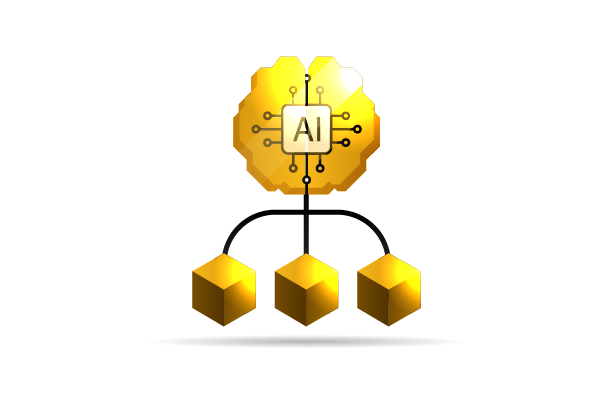
Across these projects, a few core use cases stand out:
- Trading and research: scanning markets, detecting narratives, and producing or acting on signals, as AIXBT does.
- On-chain execution: running swaps, mints, transfers, and yield strategies automatically, as Griffain and many ElizaOS agents do.
- Coordination and governance: managing DAO treasuries, voting, and agent-to-agent commerce through systems like Virtuals’ ACP and Olas’ marketplace.
- Consumer and gaming: powering livestreamers, virtual companions, and game characters such as Luna.
The takeaway is that “AI agent” covers a wide range of products. Matching a project to the specific job you care about matters more than chasing whichever token is trending.
What Are the Risks of AI Agents in Web3?
This is the section most listicles skip, and it is the most important. The AI agent sector is early and carries real risks.
- Extreme volatility. Many leading agent tokens trade 70 to 90 percent below their early-2025 peaks. Narrative momentum is not the same as fundamental value.
- Thin real adoption. A small number of agents generate genuine usage and revenue, while thousands carry negligible activity.
- Security exposure. An agent with wallet access can be drained in seconds if compromised, and researchers have flagged attacks using malicious agent “skills” that leak keys or trigger unauthorized transactions.
- Centralization. Despite decentralization branding, most projects depend on a small core team, so a loss of funding or focus can stall development.
- Regulatory and legal uncertainty. Token ownership of an agent’s output, IP rights, and compliance status all remain unsettled across jurisdictions.
The bottom line: treat AI agents in Web3 as experimental technology. Use small amounts, control your own keys where possible, and never assume a high follower count or token price reflects real safety or value.
How Should You Evaluate an AI Agent Project?
Before trusting or holding any agent, work through a short checklist:
- Does it have real, verifiable usage, or only social hype?
- Does the token actually capture value from the product, or is it just attached to it?
- Who is the team, and is the code open and audited?
- What are the security and key-custody arrangements?
- Is there enough liquidity and exchange access to exit if needed?
A project that answers these clearly is far safer to follow than one resting on a viral chart. The strongest signal in 2026 is boring but reliable: agents that people genuinely use.
Also Read: Top 10 AI Driven Cryptocurrencies to Consider this Year
Conclusion: Which AI Agents Should You Watch in 2026?
The best way to follow AI agents in Web3 is to track the layer that matches your interest. For platform exposure, Virtuals Protocol is the center of gravity. For building, ElizaOS and Fetch.ai lead the frameworks. For the decentralized AI foundation, Bittensor stands out, while AIXBT, Griffain, Olas, NEAR, Cookie DAO, and Luna each show a different slice of what agents can become.
What ties them together is potential, not certainty. This is one of the most exciting and most speculative corners of crypto, where genuine innovation sits next to heavy hype. Watch real usage rather than price charts, respect the risks, and treat every agent as early-stage technology. The projects that turn autonomous capability into sustained, real-world activity are the ones most likely to still matter at the end of the decade.
Frequently Asked Questions
What is the best AI agent in Web3 in 2026?
There is no single best agent, because the projects serve different layers. Virtuals Protocol leads agent launches, ElizaOS leads open-source frameworks, Bittensor leads decentralized AI networks, and AIXBT is the best-known live agent. The right choice depends on whether you want a platform, a framework, or a specific application.
What is an AI agent in crypto?
An AI agent in crypto is an autonomous program that combines artificial intelligence with a blockchain wallet. It can analyze on-chain and market data, make decisions, and execute actions like trades or votes without constant human input.
Are AI agent tokens a good investment?
AI agent tokens are highly speculative and very volatile, with most trading well below their peaks. They are not suitable as a safe or guaranteed investment, and this article does not recommend buying any of them. Anyone considering them should research deeply, size positions carefully, and be prepared to lose the full amount.
What is the difference between an AI agent and an AI agent platform?
An AI agent is a single autonomous program, such as AIXBT or Luna. An AI agent platform, such as Virtuals Protocol, is the infrastructure used to create, launch, and host many agents. Frameworks like ElizaOS sit alongside platforms as the toolkits developers build agents with.
Which blockchain has the most AI agents?
Base hosts the most agents through Virtuals Protocol, while Solana is a major hub via ElizaOS, Griffain, and others. Ethereum, NEAR, and several Cosmos-based networks also support growing agent ecosystems.
Are AI agents in Web3 safe to use?
They carry real risks. An agent with wallet access can lose funds if its logic fails or its keys are stolen, and malicious agent tools have been used in attacks. Use trusted, transparent projects, keep amounts small, and maintain human oversight over any agent that touches real money.
Disclaimer: The information provided by Snap Innovations in this article is intended for general informational purposes and does not reflect the company’s opinion. It is not intended as investment advice or recommendations. Readers are strongly advised to conduct their own thorough research and consult with a qualified financial advisor before making any financial decisions.

Joshua Soriano
I’m Joshua Soriano, a technology specialist focused on AI, blockchain innovation, and fintech solutions. Over the years, I’ve dedicated my career to building intelligent systems that improve how data is processed, how financial markets operate, and how digital ecosystems scale securely.
My work spans across developing AI-driven trading technologies, designing blockchain architectures, and creating custom fintech platforms for institutions and professional traders. I’m passionate about solving complex technical problems from optimizing trading performance to implementing decentralized infrastructures that enhance transparency and trust.