
What Is Agentic AI? A Comprehensive Guide to Mastering the Future of Automation
Artificial intelligence has been a helpful computer program for a long time. We are used to asking intelligence to write emails for us or to create bits of code or to summarize long reports or to make digital art. Although they have extraordinary abilities, they also have one problem: they only do something when you tell them to. After artificial intelligence is done with one task, it just stops. To resolve this problem, agentic AI emerges as a solution. So, “what is agentic AI?”. Essentially, it is an autonomous system that can work reactively and have initiation to solve the problems.
Agentic AI systems can plan, assess, and complete complex tasks with little human input. In this guide, we’ll explain what agentic AI is, how it’s different from traditional AI, its main features, real-world uses, how to set it up, and the potential risks and benefits to keep in mind.
What Is Agentic AI?
Agentic AI refers to artificial intelligence systems that possess the ability to proactively act, set plans, use external tools, and complete multi-step goals with minimal human prompting. It represents a fundamental shift away from passive chatbots toward autonomous collaborators that can navigate complex environments independently.
Unlike conventional AI models that operate on a rigid prompt-and-response mechanism, an agentic system does not simply generate a static answer to a single input. By combining advanced reasoning models with dynamic tool access and rigorous self-reflection, agentic AI transforms artificial intelligence from a passive text generator into an active, resilient problem solver capable of executing real-world workflows.
Understanding Agentic AI Loop
Below is a step-by-step explanation of how the agentic AI loop works:
Step 1: Perceive
The first step is receiving a certain goal to solve the problem.
Step 2: Plan
The AI deconstructs the high-level goal into a logical sequence of actionable, bite-sized steps.
Step 3: Act
The system selects and uses external tools, such as web searches, private databases, APIs, or code execution environments; to gather information and execute the steps.
Step 4: Reflect
The AI evaluates its own output against the original goal, recognizing any errors or dead ends, and self-corrects by looping back to adjust its plan until the objective is successfully met.
This agentic AI loop indicates that AI can adapt to the different conditions; the unexpected problems also can be solved over time through the relentless action of the AI agent by finding many alternatives. Human involvement only exists at the end of the loop to decide whether the results provided by the AI agent meet the expectations or not. If the human still wants another result, he/she can command the AI agent to find other alternatives.
Also Read: What Are Autonomous AI Agents? Definition, Roles, and Challenges
Comparison of Traditional AI, Generative AI, and Agentic AI
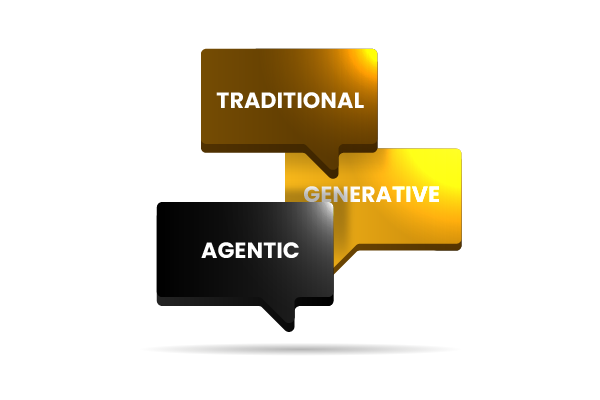
Agentic AI is commonly compared to other forms of AI such as traditional and generative AI. The table below will tell you the difference between the three types of AI above:
Table 1. Comparison between Traditional, Generative, and Agentic AI
| Feature / Capability | Traditional AI | Generative AI | Agentic AI |
| Primary Function | Pattern recognition & classification | Content generation & text summarization | Goal pursuit & autonomous execution |
| User Interaction | Rigid input → calculated output | Single prompt → single response | Broad goal → multi-step execution |
| Autonomy Level | Low (pre-programmed rules) | Moderate (requires human steering) | High (self-directed planning & action) |
| Tool Usage | Fixed to internal database | None (unless custom plugin attached) | Dynamic (APIs, browsers, execution shells) |
| Error Correction | Manual developer intervention | User must write a follow-up prompt | Autonomous self-reflection & iteration |
What Are the Key Characteristics of Agentic AI?
Agentic AI have their own characteristics that differentiate them from other AI systems. Below will be explained about five unique features of agentic AI that distinguish it from other AIs:
- Goal-Oriented Planning: As an autonomous system, agentic AI will proactively chase the plan to solve the problem. The plan will be built according to the goal that has been set before.
- Using External Tools: Another characteristic of agentic AI is accessing external tools to help them to get the best result. They can use those external tools by exploiting the usage of Application Programming Interfaces (APIs).
- Reasoning and Reflection: Agentic AI also has the capability to reason through the LLM. They can do their action autonomously and monitor if anything wrong happens. When the workflow is not effective or an error occurs, they can correct themselves and find another way to continuously solve the problem.
- Memory and Context Management: Unlike generative AI that mostly uses short-term memory, agentic AI will utilize both short-term and long-term memory. This persistent context allows them to handle complex projects without losing the thread.
- Adaptive Autonomy: The autonomous level of agentic AI can be set according to your preferences. You can set it into a fully autonomous system or a not fully autonomous system.
Also Read: What Is an AI Agent? The Comprehensive Guide to Autonomous AI
Real Use Case of Agentic AI

Agentic systems are already driving significant productivity gains across major enterprise sectors:
Software Development and Engineering
By serving as virtual engineers, agentic AI is revolutionizing software development. By cloning repositories, identifying problems, creating patches, testing modifications, and submitting pull requests, these autonomous agents are able to handle bug fixes and feature requests. In order to integrate services, they even scan API documentation, freeing up human developers to concentrate on system design while AI handles intricate coding and debugging.
Finance and Banking Operations
By managing tasks like portfolio management and reconciliation, agentic AI is changing the finance industry. It automatically watches thousands of transactions, checks for problems, prepares compliance reports and tells managers. It always looks at market trends and does real-time trading inside set risk limits in risk management.
Supply Chain and Logistics
Agentic AI helps make global supply chains stronger when things go wrong. For example, if a hurricane hits a port, agentic AI quickly figures out how it affects the shipments. Then it contacts vendors that can help send the shipments through other ports and updates when the deliveries will happen. This makes the delivery process cheaper and faster without needing people to get involved. Agentic AI does all of this work by itself.
What Are Common Mistakes To Avoid When Implementing Agentic AI?
While the promise of what is agentic AI is very bright, the path to implementation is vulnerable to potential mistakes. The following paragraph will explain about the common mistakes to avoid when implementing agentic AI:
- Over-Delegation: Instructing the AI agent with a not-clear task is an instant way to failure. You need to give a clear goal to the AI agent to prevent the AI agent from endlessly working without any right clear goals having been defined.
- Neglecting Security Architecture: Giving an AI system autonomous read and write access to enterprise software introduces significant vulnerabilities. Failing to implement the principle of least privilege means that if an agent is compromised or hallucinates a destructive command, the blast radius is organization-wide.
- Ignoring Feedback Loops: Although human involvement is not needed in the system of an agentic AI, the role of humans is still needed in deciding some major decisions. Failing to monitor and give feedback to the AI agent while they are doing their task is an unfortunate mistake that we can prevent.
Also Read: Top 10 AI Agents in Web3 to Watch in This Year
What Are the Major Benefits of Agentic AI?
The integration of agentic AI offers transformative benefits that go far beyond simple cost reduction. By operating as an autonomous entity, it drastically changes the modern workflow:
- Unconstrained Scalability: Unlike human workers, AI agents can work tirelessly 24/7 and process many tasks with the same quality. This allows businesses to scale operations exponentially without a corresponding linear increase in manpower.
- Democratization of Complex Problem-Solving: By acting as autonomous collaborators, these systems elevate the capabilities of the human workforce. A junior employee paired with an agentic AI can execute complex tasks at a level previously reserved for senior specialists, freeing humans for strategy and creative innovation.
- Accelerated Business Velocity: Agentic AI drastically reduces the time between strategy formulation and execution. By handling the logistics, data gathering, and communication natively, it turns ideas into executed reality at an unprecedented pace.
- Significant Reduction in Operational Overhead: By automating the connective tissue between software tools (like manually migrating data from a CRM to a billing platform), agentic AI drastically lowers the soft costs of business operations. It catches administrative bottlenecks before they compound, saving millions in lost productivity.
- Hyper-Personalization at Scale: In customer-facing roles, agentic AI can dynamically analyze a user’s entire history, synthesize it, and deliver a uniquely tailored response, product recommendation, or bespoke service in real-time. It provides “white-glove” concierge-level service to millions of users simultaneously, something impossible for human teams to manage alone.
What Are the Critical Risks of Agentic AI?
Despite the immense benefits, any thorough exploration of what is agentic AI must address the inherent risks of autonomous systems. Giving software the power to act independently demands a healthy respect for the dangers involved:
- Exacerbation of AI Hallucinations: When an agentic AI hallucinates, it might autonomously execute a flawed action based on false logic, such as deleting crucial files or sending inaccurate information. Because it acts independently, these errors can compound rapidly before human operators intervene.
- Data Privacy and Compliance: Agentic AI requires deep access to organizational data to function effectively. As agents pull information from various databases and emails, there is a serious risk of data leakage or unintentional exposure of personally identifiable information (PII).
- Accountability Problem: When an autonomous agent makes a critical business decision, tracking its exact chain of reasoning can be incredibly difficult. If a mistake leads to a financial loss, establishing liability becomes legally murky, requiring heavy investment in observability tools.
- Vulnerability to Prompt Injection and Manipulation: Because agentic AI interfaces directly with external environments (like reading incoming emails or scraping web pages), malicious actors can hide adversarial instructions within that data. If an agent processes a malicious prompt injection, it could be tricked into executing unauthorized commands, such as exfiltrating proprietary data or granting unauthorized system access.
Conclusion
As we navigate the technological landscape of 2026, the era of AI as a mere conversational assistant is rapidly closing. Answering the question of “what is agentic AI” reveals a profound shift toward digital autonomy. These are systems that don’t just wait to be told what to say; they figure out what needs to be done and do it. By combining the natural language understanding of generative models with goal-oriented reasoning and the ability to interact with external tools, agentic AI is positioned to become the engine of modern enterprise automation.
While the journey to implement these systems requires careful planning, stringent security measures, and a healthy respect for the risks involved, the potential rewards are staggering. Organizations that successfully harness agentic workflows will operate with a level of speed, scalability, and efficiency that will fundamentally disrupt their industries. The future of work is not humans competing against AI; it is human ingenuity amplified by tireless, autonomous digital agents.
Frequently Asked Questions
What is the difference between an AI agent and agentic AI?
An AI agent is an individual software entity designed to perform specific tasks, while agentic AI refers to the overarching paradigm and architectural framework that enables systems to act autonomously.
Can agentic AI run completely without human supervision?
While agentic AI can operate autonomously on low-risk tasks, enterprise best practices mandate human-in-the-loop oversight for high-impact decisions.
How does agentic AI access external applications?
Agentic AI connects to external applications through standardized Application Programming Interfaces (APIs), web scrapers, and execution SDKs.
What programming languages are used to build agentic AI?
Python and TypeScript are the primary programming languages used to build agentic frameworks due to their robust AI libraries and API ecosystems.
What are the leading frameworks for building agentic AI?
Popular open-source frameworks for building agentic AI include LangChain, LangGraph, AutoGen, CrewAI, and LlamaIndex.
Is agentic AI the same thing as Artificial General Intelligence (AGI)?
No, agentic AI uses narrow domain reasoning and tool access to achieve specific goals, whereas AGI represents human-level generalized intellect across all domain spaces.
How does agentic AI handle unexpected errors during execution?
Agentic AI uses internal self-reflection loops to evaluate error logs, adjust its current task strategy, and try alternative execution steps autonomously.
Disclaimer:
The information provided by Snap Innovations in this article is intended for general informational purposes and does not reflect the company’s opinion. It is not intended as investment advice or recommendations. Readers are strongly advised to conduct their own thorough research and consult with a qualified financial advisor before making any financial decisions.

Tegar Rahman Hidayah is a writer focusing on financial and artificial intelligence topics. His work ranges across various topics such as cryptocurrency, blockchain, artificial intelligence, trading technology, and financial technology solutions. His work targets the audience to understand more about AI-driven trading technology, blockchain, and solving the financial technology problems by providing solutions. By combining in-depth research with accessible narratives, he delivers insights that are both informative and engaging for a wide range of audiences.