
7 Best Institutional Trading Software for Digital Assets
A common way to trade digital assets is by doing retail trading. Retail trading is an activity of trading that focuses on personal assets and decisions solely decided by the individual. There is another type of trading that has more assets to trade on. This type of trading is commonly known as “institutional trading”.
This comprehensive guide breaks down the defining traits of the best institutional trading software for digital assets, role of institutional trading, highlights how it diverges from retail setups, how to choose the best institutional trading software, common mistakes to avoid, and reviews the best institutional trading software in the digital asset landscape.
What is Institutional Trading?
Institutional crypto trading is the purchasing and selling of cryptocurrencies by large financial organizations like banks, hedge funds, pension funds, insurance companies, asset managers, and fintech firms. They deal with enormous sums of money and have quite sophisticated technology in comparison to other traders.
While retail traders use common exchange platforms based on their own analysis or emotions, institutions have teams that help them make transactions. Furthermore, rather than just aiming for a rapid profit, their objective is to lower risk while preserving the stability of their portfolios.
Role of Institutional Trading in Today’s Market
Institutional trading is the type of trading that has influence on the development of the market because it involves large-scale transactions. The influence reflects on its role in today’s market. The following text below will tell you about the role of the institution trading in the market nowadays:
Enhanced Stability of the Market
Extreme volatility is lessened by large institutional funds. Price changes are smoother and less vulnerable to big transactions when there is more liquidity. Long-term investors find the market more appealing as a result.
Technological Progress
The employment of cutting-edge technology in trading, security, and market infrastructure is being promoted by institutions. As a result, cryptocurrency platforms are more dependable and efficient overall. In the end, retail dealers are also experiencing these improvements in the form of enhanced features.
Maturation of the Market
Institutional engagement helps the crypto industry move from a speculative market to a more sophisticated, structured, and knowledgeable financial environment. As a result, new standards for transparency and governance are set.
Credibility and Legitimacy
The arrival of well-known firms like Goldman Sachs, Fidelity, and BlackRock strongly suggests that cryptocurrency is a significant component of the global financial system rather than merely a fad. With the establishment of significant institutions, public trust is also increasing.
Pay Attention to the Fundamentals
Institutions carry out extensive study and assess initiatives according to their technology, governance, and practicality. This motivates the cryptocurrency sector to enhance transparency and quality. Projects that are fundamentally flawed are progressively being removed from the market.
Institutional Trading vs Retail Trading: Key Differences
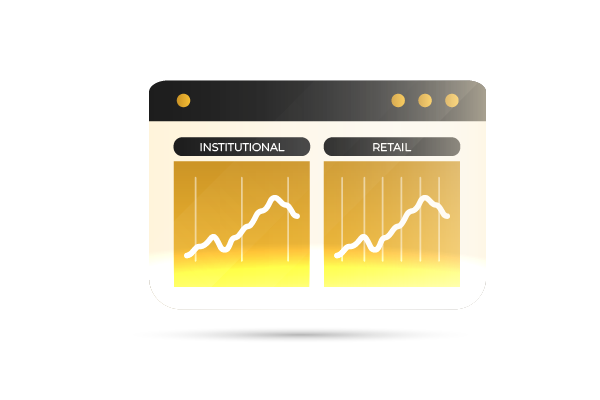
There are several major differences between retail trading and institutional trading. The key differences between those two types of trading will be explained in the table below:
| Feature | Retail Trading | Institutional Trading |
| Capital Volume | Smaller, individual accounts, limited position sizes. | Large-scale funds, blocks worth millions of dollars. |
| Liquidity & Routing | Single exchange/broker order books. | Multi-venue liquidity aggregation via Smart Order Routing (SOR) and dark pools. |
| Execution Style | Manual clicks, basic stop/limit orders via exchange interfaces. | Automation execution through Request-for-Quote (RFQ) workflows and algorithmic (TWAP, VWAP, POV). |
| Risk Management | Basic stop-losses, trailing stops, and isolated/cross margin tools. | Strict pre-trade risk controls, portfolio margining, multi-sig, and role-based access control. |
| Connectivity | Standard web UI, mobile apps, or basic REST APIs. | High-frequency, ultra-low latency FIX, WebSocket, and dedicated cross-connects (Colocation). |
| Custody & Storage | Exchange “hot wallets” or self-custody via personal hardware/software wallets. | Regulated, insured, third-party qualified custodians utilizing Multi-Party Computation (MPC) and deep cold storage. |
| Market Impact & Slippage | Minor slippage on main pairings and negligible effect on overall market values. | High risk of moving markets; relies on Over-The-Counter (OTC) desks and algorithmic slicing to minimize slippage. |
Also Read: 7+ Best AI Driven Cryptocurrencies Making Waves in 2026
7 Best Institutional Trading Software
The decision for choosing the right institutional trading platform can make or break a firm’s operational efficiency and profitability. With massive amounts of capital on the line, institutions need platforms that offer deep liquidity, airtight security, and seamless workflow automation.
Here is a breakdown of the six best institutional trading platforms available today:
1. Talos
Talos is a widely adopted execution platform heavily focused on liquidity aggregation, routing intelligence, and prime brokerage workflows. Built by traditional finance technology veterans, Talos connects institutional buy-side and sell-side firms to the entire crypto ecosystem from a single, unified interface.
- Ideal for: Talos is ideal for firms trading across many liquidity venues and needing routing flexibility, particularly for market-neutral and multi-exchange strategies.
- Pros: RFQ workflows for block and negotiated trades, portfolio and operations modules, pre- and post-trade compliance tooling, and comprehensive reporting and settlement workflows
2. Wyden
Wyden is a unified digital asset for banks and brokers that require full trade lifecycle management and workflow automation from price discovery and treasury management to best execution, settlement, and accounting.
- Ideal for: Wyden is ideal for banks, brokers, and regulated companies who prioritize workflow automation and auditable execution over the entire transaction lifecycle to underpin their compliant digital asset.
- Pros: Connectivity to 65+ exchanges, brokers, OTC desks and market makers; Best execution, smart order routing and execution algorithms; Automation of treasury, risk and settlement workflows
3. FalconX
FalconX functions as a comprehensive institutional prime brokerage platform, blending the best institutional trading software with robust financial services. By acting as both the primary source of liquidity and the operational clearinghouse, it simplifies execution.
- Ideal for: Market-neutral desks, quant funds, and corporate treasuries looking for capital efficiency.
- Pros: The consolidated clearance system is a massive operational relief, entirely removing the headache of managing separate accounts and pre-funding capital across dozens of venues.
4. Coinbase
Coinbase is a platform that has mainly focused on cryptocurrency. Despite offering the common cryptocurrency trading transaction, Coinbase also provides institutional trading for a larger-scale amount of assets.
Coinbase pairs the massive market depth of Coinbase Prime with highly customizable enterprise software. It acts as an integrated powerhouse offering execution, qualified custody, and staking services all under one regulated roof.
- Ideal for: Institutional fund managers seeking an all-in-one stop, corporate treasuries, and sizable charities.
- Pros: Great-standard regulatory compliance and top-tier custody insurance protocols.
5. Kraken
Kraken Institutional is a dedicated suite for corporate and business clients that combines the deep OTC liquidity, sophisticated execution mechanics, and powerful API capabilities of Kraken Pro.
- Ideal For: Big asset managers seeking extensive market books, cryptocurrency funds, and high-frequency algorithmic traders.
- Pros: Extreme-volume traders can benefit from extremely competitive fee structures and unparalleled global liquidity depth.
6. Binance
Binance is one of the largest crypto institutions in the world. Besides offering the trading platforms for the retailers, Binance also offers service for institutional trading. By providing VIP access to the biggest digital asset liquidity pools in the world, Binance enables institutional trading for market players at the corporate level.
- Ideal for: Institutional fund managers seeking a one-stop shop, corporate treasuries, and sizable charities.
- Pros: Binance VIP provides access to the widest variety of altcoins and derivatives on the market. For complex organizations, their sub-account management system is incredibly granular and easy to configure. VIP clients also unlock massive perks, including heavily discounted trading fees, ultra-high API rate limits for quant models, custom over-the-counter (OTC) pricing, and enterprise-grade custody insurance.
7. FlexTrade
FlexTrade is a highly flexible platform built to handle serious trading volume. By bringing together their FlexTRADER EMS and FlexONE OEMS, the software makes it incredibly easy to connect complex algorithmic trading with everyday portfolio management, giving you direct access to global liquidity pools.
- Ideal for: Asset managers, hedge funds, and brokerages looking for a heavy-duty system to manage multi-asset trades and complex order routing.
- Pros: What really stands out is its broker-neutral approach, meaning you aren’t locked into a single liquidity source when trading equities, FX, options, or futures. Because it uses an open API architecture, trading desks can easily customize their workflows and automate their own unique strategies.
Also Read: 7+ Best Artificial Intelligence Cryptocurrencies Shaping the Future in 2026
How to Choose The Best Institutional Trading Software

Choosing the best institutional trading software is essential to maximize the effectiveness of the trading. If you get the incorrect trading platform, it will ruin your trading plan and strategy. So, selecting a good one will benefit you in the trading process.
The evaluation of choosing several factors is essential because it can cause a negative financial impact on the company. Moreover, the scale of trading in this category is immense. A trading platform should be judged by how well it supports the trader’s work. If a tool does not help with analysis, orders, risk, or review, it may not be worth paying for.
Here are several factors that you should evaluate wisely when it comes to choosing the best institutional trading software:
Reliability
The best institutional trading software should have a key factor: reliability. A good platform should have high uptime and minimal latency. Because the dynamics of the prices fluctuate in any time of seconds.
Therefore, a good platform needs to update the data precisely and quickly. So, speed is crucial in the cryptocurrency market to ensure the transaction occurred in real-time.
Safety
When selecting the best institutional trading software, people should prioritize safety above all else. The reason is simple, the assets in the platform come from a lot of firms and groups with a large amount of assets, so the platform has the obligation to ensure the safety in the platform.
In order to protect users’ assets from cyberattacks, cryptocurrency exchange platforms demand multi-factor authentication, end-to-end encryption, and cold storage. Additionally, security audits show how committed the exchange is to security.
Rates
Fee schedules should be transparent and competitive. In order to ensure effective trading costs for institutions, many platforms use a maker-taker model and provide fee discounts for high volumes. Additionally, clear fees make long-term financial planning easier.
The more competitive and transparent fees also attract clients or users to take a look at the platform. People tend to choose the platform with the cheaper fees and clearer to the users. So, the best institutional trading software should has the clear and affordable rates for users.
Extensive Liquidity
Large orders can be executed by institutions with deep liquidity without having a major impact on market prices. This is essential to preventing slippage and preserving transaction efficiency. Large-scale trading strategies may not work if there is not enough liquidity.
So, choosing the best institutional trading software with a high capacity for liquidity is a must for a company that wants to take a large sum of trading in their transaction.
Solutions for Asset Management
Institutions can store, access, and manage assets in a flexible manner with the help of an effective asset management system, which enables them to react swiftly and safely to changes in the market. Additionally, this solution facilitates better asset distribution management across accounts and strategies.
Also Read: What Is Asymmetric Encryption? How Public and Private Keys Protect Data
Common Mistakes to Avoid
Risks are inevitable when trading on such a large scale as institutional trading. To keep assets safe, watch out for these common pitfalls:
Ignoring Counterparty Fragmented Risks
You run the risk of platform failures if you leave excessive capital dispersed across separate, uncleared exchanges. To protect your money, use unified credit systems or prime brokers.
Underestimating Execution Slippage
Market disruption and low execution entry prices can arise from placing large block trades without utilizing algorithmic execution tools like TWAP (Time-Weighted Average Price) or VWAP (Volume-Weighted Average Price).
Weak Internal Governance
Steer clear of shared, wide-ranging access keys. To guard against internal or external security breaches, always set up granular sub-account permissions, demand multi-signature trade authorization, and impose stringent IP allowlisting.
Inadequate Post-Trade Settlement Frameworks
Capital lockups are unneeded when instant or deferred net settlement mechanisms are not used. Your overall capital efficiency is significantly reduced if you don’t have an automated post-trade workflow, which keeps capital stuck in transit between venues.
Systemic API Rate Limiting and Uptime Faults
During periods of severe volatility, relying on software without fallback routing may cause processes to stall. The lack of an automated failover protocol to alternative liquidity pools can put you in losing positions if an exchange API throttles your access or goes offline.
Ignoring Pre-Trade Risk Controls
Conducting large orders without hard-coded pre-trade limits, such as maximum order sizes, fat-finger protection, and maximum leverage caps, leaves the firm more vulnerable to other risks such as algorithmic errors or human mistakes.
Conclusion
Institutional money entering crypto is completely changing how the market operates. It’s no longer just a space for retail day traders; we are seeing real structural maturity. Large funds and treasuries bring much-needed stability, but they require heavy-duty infrastructure to handle massive volumes. Relying on basic retail exchanges just won’t cut it anymore. Large-scale players need specialized platforms that can aggregate liquidity and route orders smartly without causing massive market swings.
Finding the best institutional trading software comes down to what your trading desk actually needs. Whether you go with the prime brokerage features of FalconX, the deep order books of Kraken, or the all-in-one custody of Coinbase, your priority should always be rock-solid reliability and security. Choosing the best institutional trading software should be done wisely and carefully. If the process is going wrong, it can lead to security breaches or problems with the assets. With the combination of the right technology and the wise choice, trading firms can confidently navigate the digital asset space.
Disclaimer: The information provided by Snap Innovations in this article is intended for general informational purposes and does not reflect the company’s opinion. It is not intended as investment advice or recommendations. Readers are strongly advised to conduct their own thorough research and consult with a qualified financial advisor before making any financial decisions.

Tegar Rahman Hidayah is a writer focusing on financial and artificial intelligence topics. His work ranges across various topics such as cryptocurrency, blockchain, artificial intelligence, trading technology, and financial technology solutions. His work targets the audience to understand more about AI-driven trading technology, blockchain, and solving the financial technology problems by providing solutions. By combining in-depth research with accessible narratives, he delivers insights that are both informative and engaging for a wide range of audiences.