
AI Agents on Blockchain: The Rise of Self-Executing Digital Workers
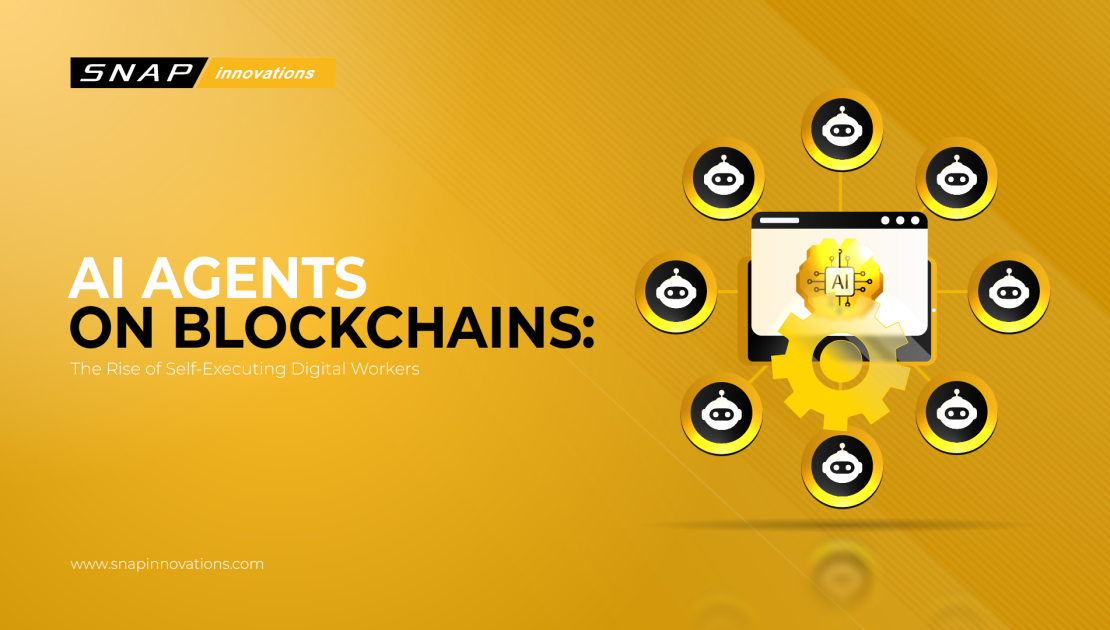
AI agents on blockchain are autonomous software programs that can perceive information, make decisions, and execute transactions directly on a blockchain without human intervention. They combine the reasoning ability of artificial intelligence with the trustless, verifiable, and automated nature of smart contracts, creating digital workers that can operate 24/7 on-chain.
In practice, this means an AI agent can hold a crypto wallet, analyze data, decide on an action, and carry it out on the blockchain, all on its own. This pairing is one of the most talked-about frontiers in both AI and Web3, because it moves blockchains from passive record-keeping toward active, autonomous participation. This guide explains what these agents are, how they work, where they are used, and the serious risks to keep in mind.
This article is for informational and educational purposes only and is not financial, investment, or trading advice. Autonomous on-chain agents and the crypto assets they interact with are high-risk and experimental. Always do your own research.
What Are AI Agents on Blockchain?
 An AI agent on blockchain is an autonomous program that uses artificial intelligence to make decisions and a blockchain to record and execute those decisions in a trustless way.
Traditional software follows fixed instructions. An AI agent, by contrast, can take a goal, evaluate changing conditions, and choose actions to reach that goal. When you place that agent on a blockchain, its actions become transparent, verifiable, and self-executing through smart contracts, and it can control its own on-chain wallet and assets.
The result is a new kind of digital actor: not a person, and not a static contract, but an autonomous entity that can think and transact on-chain.
Key takeaway: AI agents on blockchain merge AI decision-making with blockchain execution, producing autonomous programs that act independently on-chain.
How Do AI Agents on Blockchain Work?
These agents work by connecting an AI reasoning layer to on-chain infrastructure, so that decisions turn directly into blockchain transactions.
The typical flow has a few stages. First, the agent perceives data from on-chain sources, market feeds, or user instructions. Next, an AI model reasons over that data to decide what to do. Then the agent acts by signing and broadcasting a transaction from its own wallet, and smart contracts enforce and record the outcome. Finally, the agent observes the result and adjusts, creating a continuous loop of sense, decide, act, and learn.
Several building blocks make this possible: a wallet the agent controls, smart contracts that execute its actions, oracles that feed it real-world data, and increasingly an identity layer so the agent can be recognized and trusted on-chain.
Key takeaway: An AI agent senses data, decides with an AI model, and acts through its own wallet and smart contracts in a continuous loop.
Also Read: Top 18 AI Layer 1 Blockchains Powering the Agent Economy This Year
What Infrastructure Do On-Chain AI Agents Need?
 Autonomous agents need blockchain infrastructure built to support fast, low-cost, and AI-friendly execution.
General-purpose chains can host agents, but agents perform best on networks designed with them in mind, sometimes called agent-ready or AI-native chains. These provide predictable fees, quick finality so decisions execute promptly, on-chain identity for agents, and secure ways to connect AI computation to the chain. This is why the idea of an AI-native blockchain, where machine intelligence is a first-class part of the network rather than an add-on, has become central to the conversation.
Without solid infrastructure, agents face high costs, slow execution, and weak security, all of which undermine autonomy.
Key takeaway: On-chain agents rely on fast, low-cost, identity-aware infrastructure, which is driving interest in AI-native blockchains.
What Are the Main Use Cases for AI Agents on Blockchain?
AI agents on blockchain are being explored across finance, infrastructure, and everyday automation.
- Automated trading and DeFi: Agents can monitor markets, manage liquidity, rebalance portfolios, or execute strategies on decentralized exchanges around the clock.
- On-chain payments and treasury: Agents can handle recurring payments, manage a wallet’s funds, or coordinate payouts based on rules and real-time conditions.
- Data and infrastructure services: Agents can buy and sell compute, storage, or data in decentralized marketplaces, negotiating and settling autonomously.
- Governance and operations: Agents can help manage DAOs, monitor proposals, and carry out approved actions.
- Personal and business assistants: Agents can act on a user’s behalf, from managing subscriptions to executing complex multi-step tasks across protocols.
Because these agents can hold and move real value, their use cases carry real financial stakes, especially in trading and DeFi.
Key takeaway: Common use cases include automated trading, payments, data marketplaces, governance, and autonomous assistants.
AI Agents on Blockchain vs Traditional Bots and Smart Contracts
 It helps to see how on-chain AI agents differ from the tools that came before them.
| Feature | Traditional Bot | Smart Contract | AI Agent on Blockchain |
| Decision-making | Fixed rules | Fixed rules | Adaptive, AI-driven |
| Autonomy | Low to medium | Executes when triggered | High, goal-seeking |
| On-chain execution | Usually off-chain | Yes | Yes, via own wallet |
| Handles new conditions | Poorly | No | Yes, reasons and adapts |
| Transparency | Often opaque | Fully on-chain | On-chain actions verifiable |
| Controls own assets | Rarely | Holds contract funds | Yes, own wallet |
Also Read: What Is a Tokenized AI Agent? The AI You Can Co-Own This Year
The distinction is autonomy and adaptability. Bots follow scripts and smart contracts follow code, while AI agents can interpret goals and adjust their behavior, then use the blockchain to act on those decisions.
Key takeaway: Unlike scripted bots or fixed smart contracts, AI agents reason, adapt, and control their own on-chain assets.
What Are the Benefits of AI Agents on Blockchain?
The pairing offers advantages that neither technology delivers alone.
Agents bring continuous, autonomous operation, so tasks run 24/7 without human oversight. The blockchain adds transparency and verifiability, since the agent’s actions are recorded on-chain and can be audited. Together they enable trustless automation, where value moves based on logic and outcomes rather than intermediaries, and they open the door to an “agent economy” in which autonomous programs transact with one another.
For fast-moving areas like trading and DeFi, the appeal is speed and consistency, since agents do not sleep, panic, or miss a rule.
Key takeaway: Benefits include 24/7 autonomous operation, on-chain transparency, and trustless automation of value.
Also Read: What Are Autonomous AI Agents? Definition, Roles, and Challenges
What Are the Risks and Challenges?
The risks are as significant as the promise, and they deserve equal attention.
An autonomous agent that controls a wallet can also lose funds autonomously, whether through flawed logic, bad data from a compromised oracle, or a bug in its smart contracts. AI models can be manipulated or make poor decisions in unfamiliar conditions, and on-chain actions are typically irreversible. Security is a major concern, since agents are attractive targets, and questions of accountability, who is responsible when an autonomous agent causes harm, remain unresolved. In trading contexts specifically, an agent acting on volatile markets can amplify losses quickly.
These are experimental systems, so treating them with caution and strong safeguards is essential.
Key takeaway: Autonomous agents can lose funds, be manipulated, and act irreversibly, so security, oversight, and caution are critical.
Conclusion
AI agents on blockchain represent a genuine shift, turning blockchains from passive ledgers into arenas where autonomous digital workers can perceive, decide, and act. By combining AI reasoning with trustless on-chain execution, they enable everything from automated trading and payments to self-running data marketplaces and an emerging agent economy.
The potential is large, but so are the risks. These systems can move real value autonomously, which makes security, transparency, sound infrastructure, and human oversight non-negotiable. For anyone watching this space in 2026, the smart approach is to understand the technology deeply, respect the risks, and treat autonomous on-chain agents as a powerful but still experimental frontier.
Frequently Asked Questions
What is an AI agent on blockchain?
It is an autonomous program that uses artificial intelligence to make decisions and a blockchain to execute and record them. It can control its own wallet and transact on-chain without human intervention.
How is an AI agent different from a smart contract?
A smart contract executes fixed, predefined logic when triggered. An AI agent can reason, adapt to new conditions, and decide what to do, then use smart contracts and its own wallet to act on those decisions.
Can AI agents on blockchain trade crypto automatically?
Yes, agents can be designed to monitor markets and execute trades autonomously. This is powerful but high-risk, since automated trading on volatile markets can lead to fast and significant losses. It is not a guarantee of profit and is not investment advice.
Do AI agents need a special blockchain?
They can run on general-purpose chains, but they perform best on fast, low-cost networks with agent identity and AI-friendly features, often called agent-ready or AI-native blockchains.
Are AI agents on blockchain safe?
They are experimental and carry real risks, including bugs, manipulation, oracle failures, and irreversible transactions. Strong security, testing, limits, and human oversight are important, and users should never entrust more value than they can afford to lose.
What is the “agent economy”?
It refers to an emerging model where many autonomous AI agents transact, negotiate, and coordinate with one another on-chain, buying services, moving value, and operating as independent economic actors.
Disclaimer: The information provided by Snap Innovations in this article is intended for general informational purposes and does not reflect the company’s opinion. It is not intended as investment advice or recommendations. Readers are strongly advised to conduct their own thorough research and consult with a qualified financial advisor before making any financial decisions.

Joshua Soriano
I’m Joshua Soriano, a technology specialist focused on AI, blockchain innovation, and fintech solutions. Over the years, I’ve dedicated my career to building intelligent systems that improve how data is processed, how financial markets operate, and how digital ecosystems scale securely.
My work spans across developing AI-driven trading technologies, designing blockchain architectures, and creating custom fintech platforms for institutions and professional traders. I’m passionate about solving complex technical problems from optimizing trading performance to implementing decentralized infrastructures that enhance transparency and trust.