
What Is AI Agent Identity? The ID Badge Every Agent Needs
AI agent identity is a unique, verifiable digital identity assigned to an autonomous AI agent, so that systems can tell which agent is acting, who it acts for, and what it is allowed to do. It is the layer that turns “some script with an API key” into an accountable actor that can be authenticated, limited, monitored, and shut off.
As agents start moving money, changing code, and calling business systems, identity is becoming one of the most important parts of agent design. This guide explains what agent identity is, how it differs from authentication and authorization, the main technical approaches, the risks of getting it wrong, and what standards bodies like NIST are now proposing.
What Is AI Agent Identity?
AI agent identity is the set of credentials, attributes, and relationships that let a system recognize an AI agent as a distinct non-human actor.
NIST’s National Cybersecurity Center of Excellence describes AI agents as “systems that have the capability for autonomous decision-making and taking action with limited human supervision.” Its February 2026 concept paper starts from a simple question: how can existing identity standards identify software and AI agents so access systems can tell them apart from humans?
In practice, an agent identity usually answers five questions:
- Who is this agent? A unique identifier, not a shared login.
- How does it prove that? Credentials such as a token, certificate, or cryptographic key.
- Who owns it or acts through it? An accountable person, team, or organization.
- What may it do? Scoped permissions, limits, and conditions.
- Is it still valid? A lifecycle status that can be paused, rotated, or revoked.
The agent is not the same as the model behind it. The model produces decisions, while the identity is what the surrounding systems see and trust. Swap the model and the identity can stay; lose control of the credentials and the identity is compromised even if the model is fine.
Key takeaway: Agent identity answers who the agent is, who it answers to, and what it may do.
Why Do AI Agents Need Their Own Identity?
Agents need their own identity because they take real actions, and every action needs an accountable actor behind it.
Earlier software often ran under a shared service account or a long-lived API key. That works poorly for agents. Your agents make choices at runtime, chain tools together, and may be steered by untrusted text. AI agents differ from chatbots in exactly this way: a chatbot answers, an agent acts. Acting without a distinct identity creates four problems:
- No attribution. If five agents share one key, the logs cannot say which one deleted the record.
- Over-broad access. A shared credential has to carry the union of everyone’s permissions.
- Slow containment. Revoking a shared key breaks every agent that uses it.
- Weak accountability. Nobody can show who authorized the action.
The OpenID Foundation’s AI Identity Management Community Group reached a similar conclusion in its October 2025 whitepaper, recommending that enterprises treat agents as first-class identities within identity and access management, with lifecycle management, governance policies, and accountability measures.
Key takeaway: A distinct identity per agent is what makes attribution, least privilege, and fast revocation possible.
How Is Agent Identity Different From Authentication, Authorization, and Delegation?
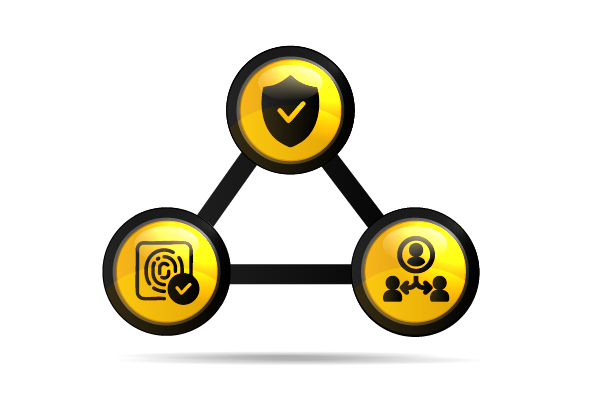 These four ideas are related but separate, and mixing them up is a common design mistake.
| Concept | Question it answers |
Example for an agent |
| Identity | Who or what is this? | invoice-agent-07, owned by the finance team |
| Authentication | Can it prove that? | Presents a short-lived signed token |
| Authorization | What may it do? | Read invoices, cannot approve payments over a set limit |
| Delegation | Whose authority is it using? | Acting on behalf of a named employee, with narrower rights than that employee |
A valid identity does not make every action valid. An agent can authenticate perfectly and still be blocked from an action that its policy does not allow. Delegation adds one more layer: the agent has its own identity, but it may also carry a limited slice of a human’s authority.
Key takeaway: Identity says who, authentication proves it, authorization limits it, and delegation links it to a person.
Also Read: Top 20 AI Layer 1 Blockchain Ecosystems to Consider This Year
What Does an AI Agent Identity Contain?
A solid agent identity record usually includes the following elements. The exact fields vary by platform, so treat this as a design checklist rather than a standard.
|
Element |
Purpose |
| Unique identifier | Distinguishes this agent from every other agent and human |
| Credentials | Proves control of the identity (keys, certificates, short-lived tokens) |
| Owner or sponsor | A named person or team accountable for the agent |
| Purpose and scope | What the agent is for, and what it may touch |
| Permissions and limits | Allowed actions, data, spending or rate caps |
| Delegation link | Which principal, if any, the agent acts for |
| Lifecycle status | Active, paused, expired, or revoked |
| Audit trail | A record of actions tied to this identity |
Key takeaway: Identity is more than a name; it ties credentials, ownership, limits, and logs together.
How Do AI Agent Identities Work in Practice?
There is no single agent identity standard yet. Teams combine several existing building blocks.
Enterprise identity platforms
Some identity providers now model agents directly. Microsoft Entra Agent ID, for example, uses an agent identity blueprint, described in its docs as “an object in Microsoft Entra ID that serves as a template for creating agent identities.”Each agent identity created from it “has its own identity, credentials, and permissions.” Admins can apply Conditional Access policies at the blueprint level, and disabling a blueprint prevents all of its agent identities from authenticating. This shows the general pattern: a managed template, many individual identities, and central control.
Workload identity
Agents run as software workloads, so workload identity standards apply. SPIFFE is described by its project as a set of open standards for securely identifying software systems in dynamic environments, using “short-lived cryptographic identity documents” (X.509 or JWT SVIDs). Short-lived, automatically rotated credentials are a strong fit for agents.
OAuth, tokens, and delegation
OAuth 2.0 and OpenID Connect are the most common way to authenticate and authorize agents at APIs. For delegation, RFC 8693 (Token Exchange) defines how one party can act for another while keeping a separate identity: “With delegation semantics, principal A still has its own identity separate from B.” Its act claim records that delegation occurred, and may_act states who is allowed to act.
The Model Context Protocol applies OAuth 2.1 to agent-to-tool connections. Its authorization spec requires clients to send a resource parameter naming the server a token is for, requires servers to check that tokens were issued specifically for them, and forbids passing through tokens meant for other services. It also recommends short-lived access tokens.
Decentralized identifiers and verifiable credentials
For agents that must be trusted across organizations, W3C standards offer another route. Decentralized Identifiers (DIDs) became a W3C Recommendation in July 2022, and the Verifiable Credentials Data Model 2.0 followed in May 2025. A DID gives an agent an identifier it controls, and a verifiable credential is a tamper-evident set of claims, such as which organization operates the agent or what authority it holds.
On-chain identity
Blockchain agents add another form: wallets and on-chain identifiers. If you are curious about agents that hold keys and transact autonomously, see what an AI citizen in blockchain is, and note that spending caps and approved contract lists matter as much as the identity itself.
Key takeaway: Most teams combine enterprise IAM, short-lived workload credentials, OAuth delegation, and optionally DIDs or verifiable credentials.
Which Agent Identity Approach Should You Use?
 The right agent identity approach depends on where your agent runs, what it accesses, and who needs to trust it. Internal services, cross-organization workflows, and blockchain transactions each have different identity requirements. Here’s how the main approaches compare in their strengths, limitations, and intended uses.
| Approach | Best for | Strength |
Limit |
| Static API keys or shared service accounts | Quick prototypes | Simple | Weak attribution, long-lived, hard to scope |
| OAuth 2.x / OIDC tokens | Agents calling APIs and tools | Widely supported, scoped, expirable | Needs a well-run authorization server |
| Workload identity (SPIFFE/SPIRE) | Agents in containers and services | Short-lived, automatic rotation | Proves the workload, not the agent’s purpose or owner |
| Enterprise agent ID platforms | Organizations managing many agents | Central lifecycle, policy, audit | Tied to one vendor’s ecosystem |
| DIDs and verifiable credentials | Cross-organization trust | Portable, signed claims | Newer; needs issuer and verifier infrastructure |
| Wallet or on-chain identity | Agents transacting on blockchains | Native to on-chain activity | Keys must be protected; says little about off-chain authority |
For internal agents that stay inside one organization, existing IAM often covers most needs. Portable credentials matter most when agents cross organizational boundaries.
Key takeaway: Match the identity method to where the agent runs and who has to trust it.
Also Read: AI Agents on Blockchain: The Rise of Self-Executing Digital Workers
What Are the Risks of Weak Agent Identity?
- Shared or long-lived credentials. One leaked key exposes everything it can reach, and no one can tell which agent used it.
- Confused deputy and token misuse. The MCP spec warns that accepting tokens issued for other services, or passing them downstream, can make a server act on authority it should not have.
- Delegation chains. The OpenID Foundation notes that today’s frameworks were not designed for recursive delegation, where agents spawn sub-agents.
- Prompt injection. Hidden instructions in content can push an agent toward actions its owner never intended. NIST specifically asks for controls that prevent and mitigate prompt injection.
- Orphaned agents. Agents that nobody owns keep their access after the project ends.
- Weak audit trails. Without an identity-linked log, incident response becomes guesswork.
Key takeaway: Most agent security failures start with credentials and permissions that are too broad, too long-lived, or not tied to a specific agent.
What Is NIST Proposing for AI Agent Identity?
NIST is working on this actively, and as of November 2026 it is still guidance in progress, not a finished standard.
- February 2026: NIST’s NCCoE released a concept paper on software and AI agent identity and authorization, covering identification, authorization, access delegation, logging and transparency, and tracking data flows. It named standards such as OAuth 2.0/2.1, OpenID Connect, SPIFFE/SPIRE, SCIM, and MCP. The comment period ran through April 2, 2026.
- September 29, 2026: NIST said it received feedback from more than 600 commenters, and that the first implementation use case will be its Secure Software Development (DevSecOps) project, which will show how agents can be identified, authenticated, and authorized in the software development lifecycle.
- October 27, 2026: NIST authors published a proposed set of ten design tenets, described as “a starting point,” including distinct agent identification, agent linking and delegation, least and zero standing privilege, short-lived and revocable authorization, human-in-the-loop triggers, mandates and constraints, separation of policy from reasoning, deterministic access decisions, continuous monitoring, and immutable evidence.
Because this guidance is still evolving, build on stable standards today and review NIST’s latest publications before you finalize a design.
Key takeaway: NIST’s direction is clear (distinct, limited, revocable, auditable), but the final guidance is not out yet.
How Do You Set Up AI Agent Identity? A Practical Checklist
- Give every agent its own identity. Never share credentials between agents.
- Name an owner. Record the accountable person or team, and the agent’s purpose.
- Use short-lived credentials. Prefer tokens that expire and rotate automatically.
- Scope permissions tightly. Start from least privilege and add access only when needed.
- Make delegation explicit. If an agent acts for a user, record that link and give it narrower rights than the user.
- Keep policy outside the model. Enforce limits in code and access systems, not in the prompt alone.
- Add approval gates. Require a human for high-impact actions such as payments, deletions, or production changes.
- Log by identity. Record every action against the agent’s ID, and protect those logs from the agent.
- Plan the end of life. Revoke credentials and archive the identity when the agent retires.
For the wider design picture, see this guide to AI agent architecture.
Key takeaway: Start with one identity per agent, short-lived access, and a human approval step for risky actions.
Also Read: What Is an AI-Native Blockchain? Built for AI From the Ground Up
Where Does AI Agent Identity Matter Most?
Identity matters wherever an agent can change something that is hard to undo.
- Finance and trading. Agents that place orders, move funds, or reconcile accounts need strict limits, approvals, and a clear record of which agent did what.
- Software development. NIST’s first planned use case is agents in automated build and deployment pipelines, where entitlements can reach production.
- Security operations. Agents that analyze alerts and take response actions need tightly bounded rights.
- Enterprise workflows. Agents that manage calendars, documents, or approvals touch sensitive data across systems.
- Blockchain applications. Agents that hold wallets and sign transactions can lose funds immediately if limits fail.
Key takeaway: The more irreversible the action, the more important the identity controls.
Conclusion
AI agent identity is the foundation for safe autonomy. It gives each agent a distinct ID, ties it to an owner, limits what it can do, and leaves a trail you can audit and revoke.
Start with the basics: one identity per agent, short-lived credentials, least privilege, explicit delegation, human approval for risky actions, and identity-linked logs. Then watch the standards: NIST and the OpenID Foundation are still shaping the details, and your design should be ready to adapt.
Frequently Asked Questions
What is AI agent identity in simple terms?
It is a unique digital ID for an AI agent, along with the credentials, owner, and permissions that go with it. It lets systems know which agent is acting and what it is allowed to do.
Is an AI agent identity the same as an API key?
No. An API key is one kind of credential. An agent identity also includes who the agent is, who owns it, what it may do, and when its access ends. A shared, long-lived API key is usually a weak identity because it cannot tell agents apart.
How is AI agent identity different from human identity?
Agents act at machine speed, run continuously, chain tools, and can be steered by untrusted content. They also do not log in with passwords or approve their own prompts. That is why agent identity tends to rely on short-lived credentials, tight scopes, and explicit delegation instead of human-style sessions.
Do AI agents need verifiable credentials or DIDs?
Not always. Internal agents often work well with existing identity and access management. Verifiable credentials and DIDs are most useful when an agent has to prove its operator or authority to a party outside your organization.
Is there an official standard for AI agent identity?
Not yet. NIST published a draft concept paper in February 2026 and proposed design tenets in October 2026, while the OpenID Foundation published a whitepaper in October 2025. Teams today combine existing standards such as OAuth, OpenID Connect, SPIFFE, and W3C credentials.
Who is responsible when an AI agent makes a mistake?
The organization or person who owns and authorized the agent is generally accountable, which is why recording an owner and a delegation link matters. Legal responsibility depends on the jurisdiction and the facts, so ask qualified counsel for your situation.
Disclaimer: The information provided by Snap Innovations in this article is intended for general informational purposes and does not reflect the company’s opinion. It is not intended as investment advice or recommendations. Readers are strongly advised to conduct their own thorough research and consult with a qualified financial advisor before making any financial decisions.

Joshua Soriano
I’m Joshua Soriano, a technology specialist focused on AI, blockchain innovation, and fintech solutions. Over the years, I’ve dedicated my career to building intelligent systems that improve how data is processed, how financial markets operate, and how digital ecosystems scale securely.
My work spans across developing AI-driven trading technologies, designing blockchain architectures, and creating custom fintech platforms for institutions and professional traders. I’m passionate about solving complex technical problems from optimizing trading performance to implementing decentralized infrastructures that enhance transparency and trust.